


Description
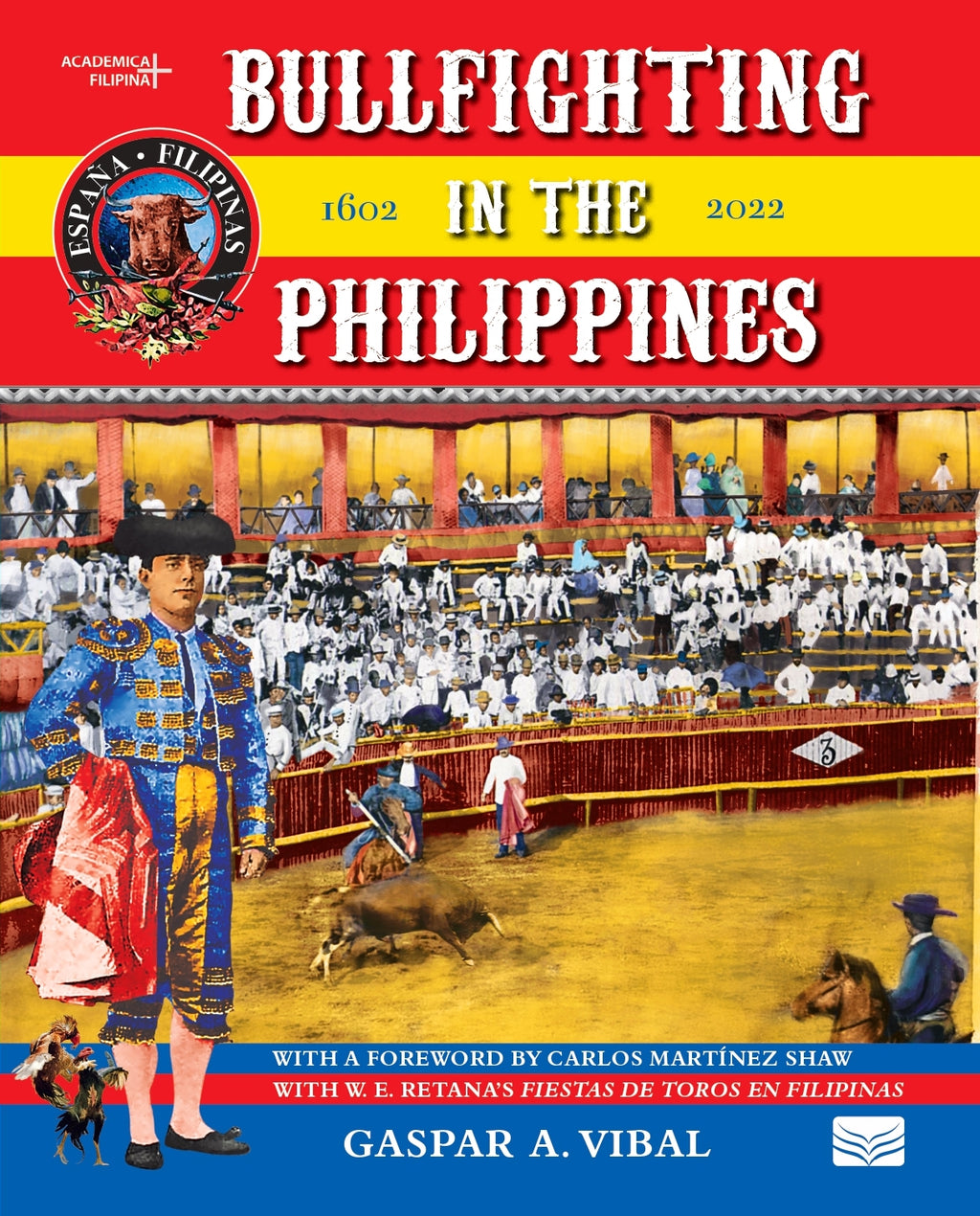
Bullfighting in the Philippines, 1602-2022
by GASPAR A. VIBAL
With a foreword by Carlos Martinez Shaw
With Wenceslao E. Retana's Fiestas de toros en Filipinas
Series: Academica Filipina +
Copyright © 2022 Gaspar A. Vibal and Vibal Foundation, Inc.
280 pages; 20.32 x 25.4 cm
This book sheds light on the very obscure Philippine branch of a celebrated Iberian tradition that has linked Spain and the Philippines for over four centuries. It pairs the pioneering work of the Spanish writer Wenceslao E. Retana (1896) with recent academic research to demystify bullfighting as practiced in the farthest colony of Spain. Although the forty-eight years of American occupation caused the taurine art to decline eventually, it found a Philippine resurgence under the championship of Pres. Ramón Magsaysay, who, in celebrating the tenth anniversary of the republic, startlingly foregrounded the performance of a doubly marginalized figure—that of an American woman bullfighter—at the last Filipino fiesta de toros.
In attempting to paint a comparative history of bullfighting in Spain and the Philippines, the book locates the marginality of its Philippine practice within the larger context of another blood spectacle—cockfighting—that has historically impeded the wider acceptance of taurine practices. Running as a thread throughout the book is the battle over the treatment of animals, which has haunted the art of bull- as well as cockfighting from the sixteenth to the twenty-first century.
Reflecting these counter-opposed attitudes, this book documents the shifting arguments in the defense of or the indictment of bullfighting. If indeed, the taurine tradition can be considered a “cultural performance,” using the concept of cultural anthropologist Clifford Geertz, what can we make of another deep-seated Philippine tradition, that of cockfighting? If the cock- and bullfight are cultural performances, for whom and why, then, are they being performed? Can both enjoy protection as cultural patrimonies just as UNESCO had inscribed the practice of falconry as an Intangible Cultural Heritage of Humanity? Thus, the comparative study of bull and cockfighting can provide an endless source of contemplation on the mysteries of the human condition as well as its propensity for mass spectacles of bloody combat.
In wanting to address a general rather than a specialized readership, the book has trained a multidisciplinary prism on the subject, using the lenses of the fine arts, architecture, theater, literature, cultural anthropology, zooarchaeology, science, philosophy, biography, transnational zoopolitics, and comparative history. Enriched with over 200 images, a bilingual taurine glossary, a global timeline, a “Who’s Who,” and the translation of Wenceslao E. Retana’s classic Fiestas de Toros en Filipinas (1896), this book provides not only a comprehensive vade mecum of Spanish and Philippine taurine history but also an entertaining literary journey through animality and humanity.
... integrates a narrative that is not only entertaining (due to its many findings) but also convincing due to the rigor of its analysis and arguments. This is a truly essential book in the construction of a universal history of bullfighting.
—From the Foreword of Carlos Martínez Shaw
Fundación de Estudios Taurinos / Real Academia de la Historia
Conforme avanza desde tiempos prehispánicos hasta nuestros días, Gaspar Vibal va tocando asuntos conexos de enorme interés, sin dejar de lado las posturas anti-taurinas, que son tan antiguas como el propio espectáculo. En definitiva, Bullfighting in the Philippines es un libro bien documentado, bien contextualizado y lleno de curiosidades, que no está pensado únicamente para los aficionados a los toros.
—Fernando Palanco
Historiador y autor de Inquisición en Filipinas
For fanciers of historical topics obscure, unusual, neglected, and forgotten (as I am), this is a book that surprises, educates, and delights. But Gaspar Vibal’s Bullfighting in the Philippines, 1602-2022 is more than just a book for aficionados. It is a work of high scholarship: deeply researched, theoretically informed, clearly written, and excellently illustrated.
A most exhaustive study, the book ranges through such topics as the history of bulls and horses in the Philippines, bullfighting events from the seventeenth century to the present; a who’s who of Spanish and Philippine bullfighting; bullrings in Manila and the provinces; and more. It looks at the relations between Spanish bullfighting to local forms of animal combat (like cockfighting and carabao duels), relates little-known stories like that of the female bullfighters of Iloilo, and even includes a note on the subcultural figure of the toro in the popular imagination.
Beyond documenting, Vibal offers cross-cultural reflections on the political, cultural, ethical, and philosophical issues raised by bullfighting and similar blood spectacles. This is a remarkable book that excites and reminds us that – despite the sense of many that much historical writing in the country seems a case of more of- the-same—Philippine history is a field in which there is still so much that remains to be known, discovered, richly imagined.
—Resil Mojares
National Artist of the Philippines for Literature
CONTENTS
Foreword by Carlos Martínez Shaw vii
Preface xiv
Introduction xvii
1
Philippine Bull and Horse Stories
The Ancient Origins of Livestock and Bullfighting 3
2
Splendors of the Fiestas de Toros
The First Philippine Bullfights, c. 1602–1800 31
3
Between Modernity and Revolution
Nineteenth-Century Philippine Bullfighting 83
4
The Zoopolitics of Nation-Building
Philippine Bullfighting in the Modern Era, 1898–2022 139
Appendices
1 Bullfighting Glossary 205
2 Bullfighting Timeline in the Philippines and Elsewhere 210
3 Who’s Who of Spanish and Philippine Bullfighting 215
4 Table of Philippine Bullfights, c. 1602–2022 221
5 Una Plaza de Toros, A Bullring [in Paco] (Manila, 1886) 223
6 Corrida de beneficencia, The Charity Bullfights (Manila, 1890). 225
7 Wenceslao E. Retana, La corrida y su consecuencia (Manila, 1907) 228
8 Wenceslao E. Retana, Fiestas de Toros en Filipinas (Madrid: 1896) 233
Bibliography 242
Index 255
ABOUT THE SERIES
Academica Filipina+ is an interdisciplinary series that pushes the boundaries of scholarly publishing with smart, literate, and thought-provoking works exploring the Philippine past, present, and future
Refund Policy
Returns
Our policy lasts 30 days. If 30 days have gone by since your purchase, unfortunately we can’t offer you a refund or exchange.
To be eligible for a return, your item must be unused and in the same condition that you received it. It must also be in the original packaging.
Several types of goods are exempt from being returned. Perishable goods such as food, flowers, newspapers or magazines cannot be returned. We also do not accept products that are intimate or sanitary goods, hazardous materials, or flammable liquids or gases.
Additional non-returnable items:
Gift cards
Downloadable software products
Some health and personal care items
To complete your return, we require a receipt or proof of purchase.
Please do not send your purchase back to the manufacturer.
There are certain situations where only partial refunds are granted (if applicable)
Book with obvious signs of use
CD, DVD, VHS tape, software, video game, cassette tape, or vinyl record that has been opened
Any item not in its original condition, is damaged or missing parts for reasons not due to our error
Any item that is returned more than 30 days after delivery
Refunds (if applicable)
Once your return is received and inspected, we will send you an email to notify you that we have received your returned item. We will also notify you of the approval or rejection of your refund.
If you are approved, then your refund will be processed, and a credit will automatically be applied to your credit card or original method of payment, within a certain amount of days.
Late or missing refunds (if applicable)
If you haven’t received a refund yet, first check your bank account again.
Then contact your credit card company, it may take some time before your refund is officially posted.
Next contact your bank. There is often some processing time before a refund is posted.
If you’ve done all of this and you still have not received your refund yet, please contact us at marketing@vibalgroup.com.
Sale items (if applicable)
Only regular priced items may be refunded, unfortunately sale items cannot be refunded.
Exchanges (if applicable)
We only replace items if they are defective or damaged. If you need to exchange it for the same item, send us an email at marketing@vibalgroup.com and send your item to: 3F Cyberpark Tower 1, G. Aguinaldo Street, Araneta Center, Cubao, Philippines Quezon City PH 1109.
Gifts
If the item was marked as a gift when purchased and shipped directly to you, you’ll receive a gift credit for the value of your return. Once the returned item is received, a gift certificate will be mailed to you.
If the item wasn’t marked as a gift when purchased, or the gift giver had the order shipped to themselves to give to you later, we will send a refund to the gift giver and he will find out about your return.
Shipping
To return your product, you should mail your product to: 3F Cyberpark Tower 1, G. Aguinaldo Street, Araneta Center, Cubao, Philippines Quezon City PH 1109
You will be responsible for paying for your own shipping costs for returning your item. Shipping costs are non-refundable. If you receive a refund, the cost of return shipping will be deducted from your refund.
Depending on where you live, the time it may take for your exchanged product to reach you, may vary.
If you are shipping an item over $75, you should consider using a trackable shipping service or purchasing shipping insurance. We don’t guarantee that we will receive your returned item.